We run clinical trials of medicinal products in Poland, Ukraine and other Eastern European countries — Phase II to Phase IV, plus large post-marketing and non-interventional studies. Pharmaxi is a mid-sized CRO founded in Warsaw in 2013 by two physicians, working with sponsors from 21 European and North American countries. This page covers the study types we take on, how a drug application moves through the EU regulatory route, which services we deliver, and where the studies actually run.

What We Run
| Study type | What it covers |
|---|---|
| Phase II | Dose finding and first efficacy signals in the target population |
| Phase III | Confirmatory, multi-centre, usually multi-country |
| Phase IV | Post-authorization studies, including regulatory commitments |
| Post-marketing and non-interventional | Real-world data on products already on the market |
| Registries and epidemiological studies | Long-running data collection across many sites |
| Retrospective studies | Analysis of data already generated |
Therapeutic areas with completed projects: cardiology, endocrinology, gastroenterology, pulmonology, pediatrics, nephrology, gynecology, oncology, neurology, rheumatology and orphan diseases.
For clinical monitoring taken as a standalone service, we cover Phase 1 through Phase 4. For full study delivery, Phase II to Phase IV is the range where we take responsibility for the whole trial.
The Regulatory Route for a Medicinal Product in the EU
A drug trial in the EU runs under Regulation (EU) No 536/2014, and the route is not the one a team used to the FDA expects. The application goes into CTIS as a single dossier, then splits: Part I — protocol, investigational medicinal product quality, benefit–risk — is assessed jointly under a reporting Member State, while Part II — informed consent, site and investigator suitability, data protection — is assessed by each participating country separately. Each Member State then issues its own national decision.
The regulation sets the clock: validation within 10 days of submission, the Part I assessment report within 45 days of validation, and the single national decision within 5 days of the reporting date (Articles 5–8). Sixty days is the floor for a clean application. Every request for further information adds to it, and a five-country study means five national timelines to track rather than one.
Two things sit outside the regulatory authority’s route and are frequently underestimated: the ethics committee opinion is a separate process, not a step inside the agency assessment, and every country needs its own translated informed consent forms and IMP labels.
We handle this end to end — see CTIS submission services for the submission itself and regulatory affairs for interaction with national agencies and ethics committees in Poland and Ukraine.

Services Across the Study
Every function below is delivered in-house, and each can be taken on its own or as part of full study conduct:
- Clinical operations — study set-up, site selection, start-up and delivery
- On-site clinical monitoring — monitoring visits, source data verification, protocol deviation follow-up
- Regulatory affairs — submissions for drugs in Poland and Ukraine, agency and ethics committee interaction
- CTIS submission services — OMS registration, sponsor accounts and roles, Part I and Part II documentation, through to results submission
- Data management — eCRF build, validation, query management, database lock
- Biostatistics — sample size, statistical analysis plan, analysis and reporting
- Medical writing — protocol, clinical study report, submission documentation
- Project management — one point of accountability across the study
- Vendors management — oversight of drug depot, logistics, insurance and delivery, which we delegate to vetted subcontractors
- Clinical trial consulting — study design, feasibility and budgeting before anything is committed
Data Capture: OnlineCRF
Studies run on OnlineCRF, our own electronic data capture system — built by the CRO that uses it, not licensed from a vendor. It is developed in compliance with 21 CFR Part 11, validated under GAMP 5 and GCDMP principles, and configured per protocol under 17 data management SOPs covering configuration, validation and verification.
For a sponsor the practical consequence is commercial rather than technical: no third-party licence is being resold, and a configuration change after a protocol amendment is an internal task rather than a vendor negotiation.
Who We Work With
Pharmaceutical companies
Sanofi, AbbVie and Takeda are among our sponsors. Work at this scale is usually a defined scope inside a larger programme — monitoring in a set of countries, data management for a study, or a regulatory route we cover and the sponsor does not.
Biotech and small sponsors
Sankom, Peptigroup and Flyser are the other end of the range: companies with one or two assets and no internal clinical operations function, outsourcing most of the trial rather than selected parts of it. That work has its own constraints, and we cover them on the biotech CRO page.
Generic and post-authorization sponsors
Post-marketing commitments, registries and non-interventional studies run on a different economic logic from a registration trial — larger patient numbers, lighter per-patient procedures, longer duration. Our late-phase platform is built for that.
Engagement Models
Two ways to work with us, described in full on clinical trial support services:
Full study conduct — we deliver the complete cycle, from study design negotiation to the final study report. This fits sponsors with no internal clinical operations function.
Functional support (FSP) — one or more functions are outsourced while study management stays with you. This fits sponsors who have a study manager and a specific capability gap. The model is covered in more depth in functional service provider.
In both cases the sponsor keeps ultimate responsibility for the trial. Under ICH E6(R3), activities not specifically transferred in the agreement remain with the sponsor by default — which makes the transfer-of-duties schedule worth reading line by line before signing.
Where We Run Studies
Poland, Ukraine and other Eastern European countries, with multi-country delivery through a network of 79 partner companies across Germany, the Netherlands, France, Israel, South Korea and the United States.
The region is chosen for a practical reason: large public hospitals concentrate patients in single centres, which means fewer sites for the same enrollment, and the data are generated inside the EU regulatory framework and go into the same dossier. More detail in why Poland is a perfect place for clinical trials and the role of Eastern Europe in global clinical trials.
Evidence
Completed drug trials, with patient and site numbers:
| Study | Patients | Sites |
|---|---|---|
| Moderate COVID-19, multi-centre randomized double-blind placebo-controlled | 540 | 17 |
| Chronic pancreatitis, randomized double-blind double-dummy | 210 | 7 |
| Prostate carcinoma, PK/PD of a depot formulation, single-blind parallel group | 160 | 8 |
| Relapsing-remitting multiple sclerosis, phase III international assessor-blind | 125 | 6 |
| Prevention of post-abdominal-surgery incisional infection, phase II | 120 | 9 |
| Complicated UTI including acute pyelonephritis, multi-centre randomized double-blind | 110 | 6 |
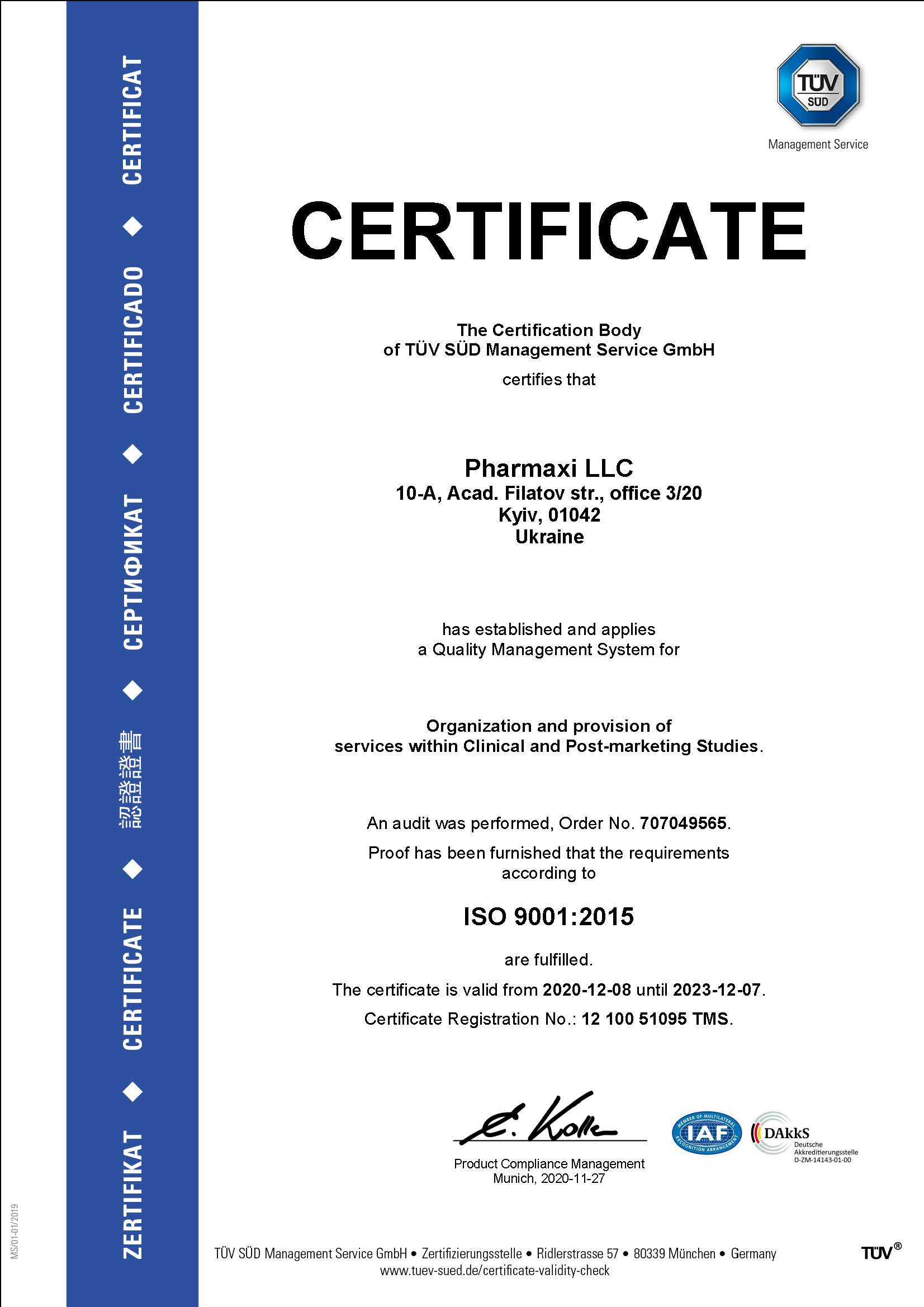
Quality management is certified to ISO 9001:2015 by TÜV Austria. Data systems are covered by declarations of conformity to 21 CFR Part 11 and ISPE GAMP 5.
“Working together since 2014 — an epidemiological multicentre study in Ukraine and the Baltic countries in hepatitis C. The design and management of the clinical databases deserve particular mention.”
— Galina Bryn, Ukraine & CIS Medical Manager, AbbVie
Frequently Asked Questions
What counts as a medicinal product in a clinical trial?
A substance intended to treat or prevent disease in humans, or to make a medical diagnosis or restore a physiological function. In a trial it is the investigational medicinal product (IMP), governed by Regulation (EU) No 536/2014. Medical devices and IVDs are separate categories under MDR 2017/745 and IVDR 2017/746, with a different route.
Which phases do you run?
Phase II to Phase IV for full study delivery, plus large post-marketing and non-interventional studies. Taken as a standalone service, clinical monitoring covers Phase 1 through Phase 4. We do not run drug discovery or preclinical work.
How long does it take to start a drug trial in the EU?
The regulatory floor is about 60 days for a clean application: 10 days validation, 45 days for the Part I assessment report, 5 days for the national decision (Regulation (EU) No 536/2014, Articles 5–8). Requests for further information extend it. Site contracts and ethics submissions run in parallel with that clock, so the practical start-up time depends on how early they begin.
Do you work with small pharmaceutical companies?
Yes — small and medium-sized sponsors are a core part of the client base, alongside large pharma. For a sponsor with no internal clinical operations function, full study conduct is usually the right model.
What is the difference between a medicinal product study and a medical device study?
The regulation. Drug trials run under EU CTR 536/2014 through CTIS; device studies run under MDR 2017/745 and IVD performance studies under IVDR 2017/746, outside the CTIS route. The evidence requirements, documentation and timelines all differ. Our device work sits on the medical devices pages.
Who is responsible for the trial — the sponsor or the CRO?
The sponsor. ICH E6(R3) allows a sponsor to transfer any or all trial-related activities to a service provider, but ultimate responsibility for participants’ rights, safety and well-being and for the reliability of the data stays with the sponsor.
Talk to Us About Your Study
Book a free 30-minute consultation with a project manager, regulatory expert, medical writer or data manager — 09:00–18:00 Polish time. No cost, no obligations.