A CRO (contract research organization) — is a company a sponsor hires to run part or all of a clinical trial: study design, regulatory submissions, site selection, monitoring, data management, statistics and the final report. The sponsor keeps legal responsibility; the CRO performs the transferred duties under contract. That split is where most explainers go wrong, and it decides who signs what and who answers an inspector. This page covers what a CRO does at each stage, the types you can hire, who uses them, how to compare vendors, and how the model works under EU rules in Poland.

What Is a CRO (Contract Research Organization)?
The industry’s own definition sits in the ICH E6 Good Clinical Practice guideline:
“A person or an organization (commercial, academic, or other) contracted by the sponsor to perform one or more of a sponsor’s trial-related duties and functions.”
— ICH E6 Good Clinical Practice guideline, glossary
Two things follow. Duties are transferred, not surrendered: whatever a contract research organization CRO agreement covers must be written down, and anything left out stays with the sponsor. And the sponsor keeps ultimate responsibility for data quality and integrity, which is why a CRO never “takes over” a study — it executes.
What the sponsor keeps, whatever the contract says:
- Accountability for data quality, integrity and participant safety
- The regulatory sponsor role, unless a legal representative is appointed
- Sign-off on the protocol, the analysis plan and the study report
- Oversight of the CRO: qualification, escalation routes, documented review
Contract Research Organization vs Clinical Research Organization: What’s the Difference?
There is no difference in what the companies do. “Contract research organization” is the GCP term, used in contracts; when someone writes CRO clinical research organization, they mean the same vendor, usually because the phrase came from a job advert. Buyers looking for a CRO clinical research partner reach the same shortlist either way.
Where the confusion costs money is the neighbouring acronyms:
| Term | In the GCP glossary? | Who uses it | What it refers to |
|---|---|---|---|
| Contract research organization (CRO) | Yes | Sponsors, regulators, contracts | Performs transferred sponsor duties |
| Clinical research organization (CRO) | No | Job ads, recruiters, marketing | The same companies, informally |
| Site management organization (SMO) | No | Sites, some sponsors | Manages sites, not sponsor duties |
| Contract development and manufacturing organization (CDMO) | No | CMC and supply teams | Makes the product, including IMP supply |
A sponsor can contract a CRO and a CDMO on one programme. They meet at IMP release and shipment — a handover that belongs in both contracts.
What Does a CRO Do in a Clinical Trial?
What a CRO does for clinical trials depends on the contracted scope. The stages below overlap: site contracting runs alongside the ethics submission, recruitment starts before the last site is activated, and data cleaning continues into follow-up.
Study design and feasibility
- Protocol and endpoint feasibility, sample size agreed with the statistician
- Site feasibility: questionnaires, catchment estimates, competing-trial checks
- Enrollment modelling in patients per site per month, with a documented basis
Sites over-report their eligible population, and an unchallenged number becomes the curve the sponsor is judged against.
Regulatory submission and start-up
- Dossier compilation: protocol, IB, IMPD, ICFs, labels, insurance
- Submission to the competent authority and to the ethics committee — separate processes, separate questions
- Site contracts, indemnity, IMP import and depot arrangements
- Initiation visits, delegation logs, protocol and eCRF training
Contract negotiation, not regulatory review, causes most start-up delay.
Site activation and recruitment
- Green-light checks: approvals in place, drug delivered, systems live, staff trained
- Enrollment tracking per site, with early flagging of non-recruiters
- Rescue actions: adding sites, reallocating targets, amending eligibility if the data allow
Monitoring, data management and safety
- On-site and remote visits, source data verification, protocol deviation logs
- eCRF design and validation, edit checks, query resolution, medical coding
- Pharmacovigilance: SAE intake, expedited SUSAR reporting, the annual safety report
Risk-based monitoring cuts visits and cost, but moves the load onto central data review, and needs a sponsor comfortable with signal detection instead of a visit report per site.
Database lock, analysis and reporting
- Query resolution to zero open items, coding sign-off, data review meeting
- Database lock, unblinding, execution of the statistical analysis plan
- Tables, listings and figures, the clinical study report, eTMF archiving
What Types of CROs Are There?
Four criteria decide which vendors belong on a shortlist:
| Criterion | Options | What it means for your study |
|---|---|---|
| Service scope | Full-service · functional (FSP) · niche | Full-service transfers management; FSP keeps it in-house and buys single functions |
| Specialisation | Therapeutic area · product type · study type | Device and IVD studies follow a different regulation and route |
| Geography | Global · regional · single-country | A regional CRO knows national ethics practice; a global one adds reach and account layers |
| Size | Large · mid-size · boutique | Large brings capacity; mid-size puts senior people on the study, not the pitch |
Scope is the consequential choice. Full-service and functional service provision differ in who holds the plan, not who does the tasks; the mid-size CRO trade-off has its own page, and both models sit on our clinical trial support services page.
Who Works with CROs: Pharma, Biotech and Medical Device Sponsors
Pharmaceutical companies
A large pharmaceutical company runs a preferred-provider panel and treats a CRO pharma relationship as capacity management: internal teams keep the strategy and hand out execution by function or region. Smaller pharma buys whole delivery, having no clinical operations department of its own. The difference between a good and a poor pharmaceutical CRO shows up in the first feasibility conversation.
Biotech and early-stage sponsors
A biotech sponsor usually has one asset, one financing runway and no operational infrastructure, so the CRO becomes its clinical operations department. Senior-staff continuity then matters more than vendor headcount: a study that loses its project manager twice will slip whatever the size of the company behind it.
Medical device, IVD and SaMD companies
Device sponsors are not running a clinical trial in the CTR sense. A device investigation sits under the Medical Devices Regulation and an IVD performance study under the IVD Regulation, both following ISO 14155 rather than the medicinal-product route: different forms, different national practice, different documentation. Software as a medical device adds validation expectations. See our medical device studies pages.
The Role of a CRO in Drug Development
Programme economics are why the model exists. The Tufts Center for the Study of Drug Development put the capitalised cost of one new drug at about $2.6 billion (2016); a later analysis in JAMA, 2020, estimated a median near $985 million. The gap depends on indication, trial size and how many failures are capitalised in.
Against numbers like these, a sponsor buys three things from a drug development CRO:
- Access to sites, investigators and patients it has no relationship with
- Capacity that scales down again at close-out, instead of permanent headcount
- Regulatory experience in markets where it has never filed
A CRO does not get a product approved. It produces the evidence and assembles the submission; the decision belongs to the authority, the application to the sponsor.
CROs in Europe: Regulatory Context and Why Poland
Since the EU Clinical Trials Regulation (Regulation (EU) No 536/2014) became applicable on 31 January 2022, an EU trial is submitted once, through the Clinical Trials Information System; legacy studies had to finish transitioning from the old Directive by 30 January 2025. That changes what a European CRO is hired for:
- Part I — protocol, IMP quality, benefit-risk — is assessed jointly, coordinated by one reporting member state
- Part II — consent, site and investigator suitability, data protection — is assessed by each country separately
- Every country still needs its own translated ICFs, labels and site contracts
- Device and IVD studies stay outside this route, under MDR and IVDR
Poland carries a large share of European enrollment for structural reasons: public hospitals with wide catchment areas, GCP-trained investigators, and sites less saturated with competing trials than in Western Europe. The national act on clinical trials adopted in 2023 reorganised the ethics route so that a single national bioethics committee issues the Part II opinion, with URPL as the competent authority. The trade-off is real: coordinator capacity is thinner than the investigator bench suggests, so start-up support matters more here. More in why Poland works for clinical trials and Eastern Europe’s role in global studies; filing mechanics sit on our CTIS submission and regulatory affairs pages.

Frequently Asked Questions
What does a CRO do in clinical trials?
A CRO performs the sponsor duties written into its contract — usually feasibility, regulatory submission, site contracting and initiation, monitoring, data management, biostatistics and pharmacovigilance. Scope runs from one function to the whole study, and anything not listed stays with the sponsor.
What does CRO stand for?
CRO stands for contract research organization. In job adverts and casual use you will also see it expanded as clinical research organization; both name the same type of company. GCP uses “contract research organization”, so that is the form for protocols and contracts.
What is the difference between a CRO and a sponsor?
The sponsor initiates the trial and takes responsibility for it; the CRO carries out some of the sponsor’s duties under contract. Transferred duties must be specified in writing, and the sponsor keeps ultimate responsibility for data quality and participant safety however much is delegated.
What is the difference between a CRO and a CMO/CDMO?
A CRO runs research: studies, data, submissions. A CMO or CDMO develops and manufactures the product, including investigational medicinal product supply and packaging. Many programmes use both, and the interface — IMP release, labelling, shipment — belongs in both contracts.
What are the advantages of outsourcing to a CRO?
Access to sites and investigators the sponsor has no relationship with, experience in countries where it has never filed, and capacity that shrinks again at close-out. The trade-off is oversight: outsourcing execution does not outsource accountability, and someone at the sponsor still reviews the output.
How much does it cost to work with a CRO?
Pricing is built per study, driven by countries and sites, patient numbers, visit schedule, monitoring model, duration and the volume of data per patient. Ask for the change-order policy and the monitoring assumptions — amendments and added visits, not the base fee, are what move a budget.
What is a full-service CRO?
A full-service CRO delivers the whole study, from design to the clinical study report, and holds the project plan itself. The alternative is functional outsourcing, where the sponsor keeps study management and buys individual functions. Both sit on our clinical trial support services page.
Pharmaxi as a CRO in Poland and Eastern Europe
Pharmaxi is a mid-sized CRO founded in 2013 by two physicians. We deliver phase II–IV studies and large non-interventional programmes, and monitor from phase 1, as full study conduct or as functional support. Sponsors come from 21 European and North American countries: Sanofi, AbbVie and Takeda alongside Sankom and Peptigroup.
What that looks like in practice:
- A COVID-19 multi-centre randomised double-blind study: 540 patients across 17 sites
- A phase III relapsing-remitting multiple sclerosis study: 125 patients across 6 sites
- Our own EDC, OnlineCRF, built in compliance with 21 CFR Part 11, validated per GAMP 5 and governed by 17 data management SOPs
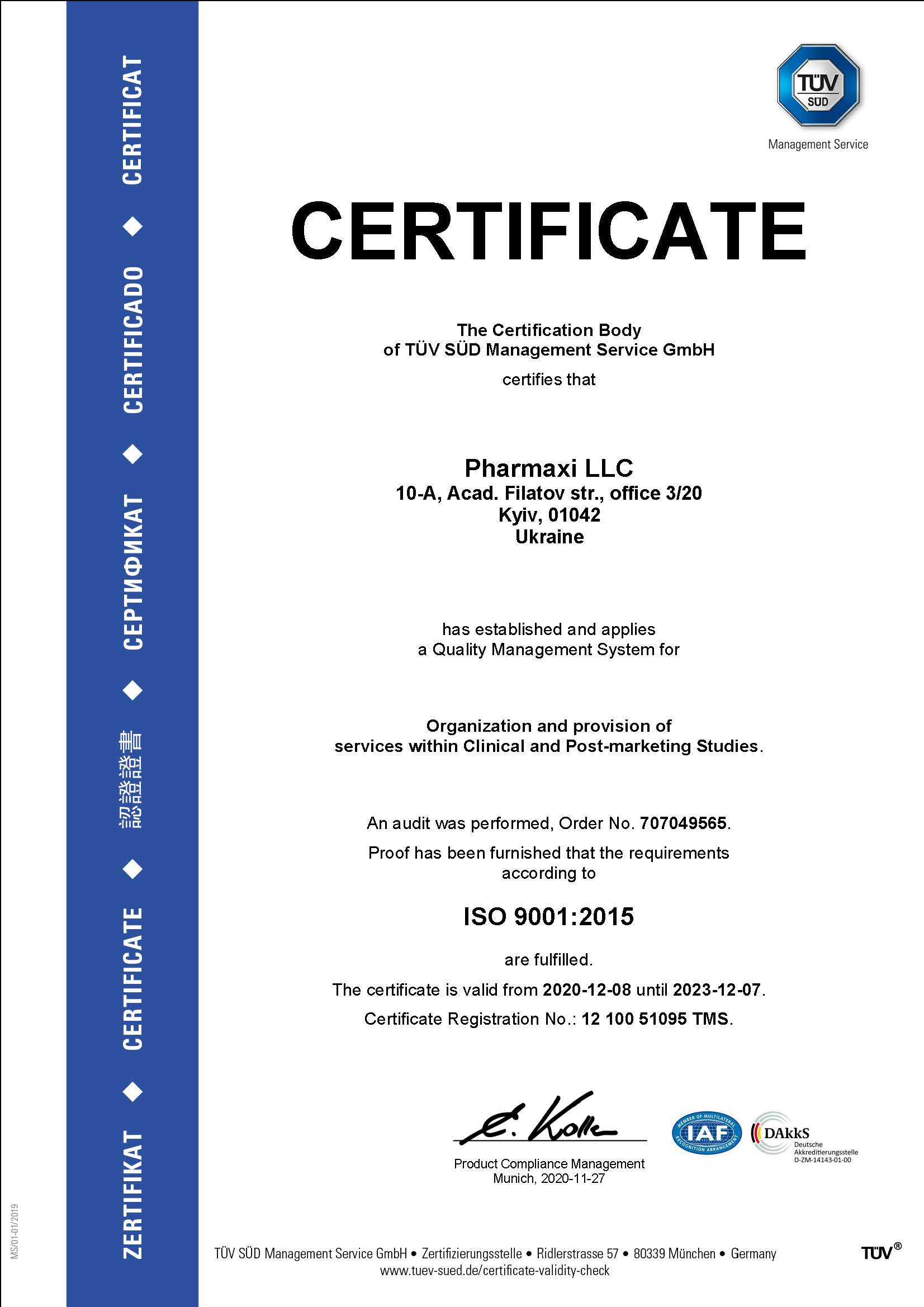
- ISO 9001:2015 certification held since 2017, issued by TÜV Austria
“We’ve been working with Pharmaxi since 2014 in frame of epidemiological multicentre study in Ukraine and the Baltic countries.”
— Galina Bryn, Ukraine & CIS Medical Manager, AbbVie
Completed projects are listed on the about us page. For a view on whether your protocol is deliverable here, and at what enrollment rate, book a free 30-minute consultation. No cost, no obligations.
References
- ICH E6 Good Clinical Practice guideline, International Council for Harmonisation; R3 adopted 2025.
- Regulation (EU) No 536/2014 (EU CTR); applicable 31 January 2022, transition completed 30 January 2025.
- Clinical Trials Information System (CTIS), European Medicines Agency.
- Regulation (EU) 2017/745 (MDR); Regulation (EU) 2017/746 (IVDR).
- ISO 14155, Clinical investigation of medical devices for human subjects.
- DiMasi JA, Grabowski HG, Hansen RW. New estimates of drug development R&D costs. Journal of Health Economics, 2016.
- Wouters OJ, McKee M, Luyten J. Estimated R&D investment to bring a new medicine to market, 2009–2018. JAMA, 2020.
- Act on clinical trials of medicinal products for human use, Poland, 2023.
- Office for Registration of Medicinal Products, Medical Devices and Biocidal Products (URPL), Poland.