A biotech CRO is a contract research organization that runs clinical trials for biotechnology companies — usually small ones, developing one or two assets, with no in-house clinical operations department. The regulatory work is identical to what large pharma requires. The constraints are not: one asset instead of a portfolio, a timeline set by the next funding round, and no second programme to absorb a delay.
This page covers what a CRO does for a biotech sponsor, when to bring one in, how full-service and functional models differ, what to ask during an RFP, and what changes when the trial runs in Poland and Central and Eastern Europe.
What Is a Biotech CRO?
There is no separate regulatory category for a “biotech CRO”. Under ICH E6(R3), the revision of Good Clinical Practice adopted in January 2025, a CRO is one kind of service provider:
“A person or organisation (commercial, academic or other) providing a service used by either the sponsor or the investigator to fulfil trial-related activities.”
— ICH E6(R3), glossary
What makes a CRO a biotech CRO is who it serves and how it is set up to work. A CRO built around large-pharma programmes expects a sponsor with its own clinical operations, quality and regulatory functions on the other side of the table, and it staffs an account structure to match. A biotech sponsor often has three or four people in total, one of whom is the CEO, and needs the CRO to supply the functions the company does not have yet rather than to interface with functions it already runs.
One point matters more here than anywhere else, because lean teams are where it goes wrong. Transferring activities to a CRO does not transfer accountability. E6(R3) is explicit: a sponsor “may transfer any or all of the sponsor’s trial-related activities to a service provider… however, the ultimate responsibility… resides with the sponsor” (section 3.6.6). And the default runs against you — under section 3.6.4, “the sponsor’s trial-related activities that are not specifically transferred to and assumed by a service provider are retained by the sponsor.” Anything the agreement forgets to name stays yours. Read the transfer-of-duties schedule line by line before signing it; it is the document an inspector will ask for.
Biotech vs Large Pharma: What Changes for the CRO
| Small or emerging biotech | Large pharma | |
|---|---|---|
| Assets in development | One or two, often a single indication | A portfolio across therapeutic areas |
| Share of the trial outsourced | Most of it, including functions that will never be built in-house | Selected functions; core capability stays internal |
| Who decides | The CEO or CSO, frequently in the same call | A committee, through a procurement process |
| What sets the timeline | The runway and the next financing or partnering milestone | Portfolio planning and launch sequencing |
| Cost of a three-month slip | Existential — there is no second programme to report on | Absorbed by the portfolio |
| What matters most in the CRO | Senior people actually on the project; a straight answer when something breaks | Global footprint, systems integration, governance |
The practical consequence is about seniority, not size. On a large-pharma programme the experienced people design the approach and hand delivery to a wider team. A biotech sponsor with no internal clinical operations function needs those people to stay on the study — because when a site misses its enrollment target in month four, there is nobody on the sponsor side whose job it is to notice.
What Does a CRO Do for a Biotech Company?
The scope below is what a full study conduct engagement covers. In practice these stages overlap: site contracts and ethics submissions run in parallel, recruitment starts before the last site is activated, and data cleaning continues while patients are still in follow-up.
Study design and feasibility
- Protocol development, endpoint selection and sample size
- Feasibility: what enrollment rate the chosen countries and sites can actually deliver, expressed as patients per site per month
- Country and site mix, against competing trials in the same indication
- Budget and a risk assessment of the assumptions the plan depends on
Feasibility is where optimism is cheapest. A site that promises four patients a month on the feasibility call and delivers one is the most common reason a study needs rescuing eighteen months later. More on the planning stage under clinical trial consulting.
Regulatory submission in the EU
- The clinical trial application dossier, assembled for submission through CTIS
- Part I — the scientific and product documentation, assessed jointly with a reporting Member State
- Part II — the national and ethics documentation, assessed by each Member State separately
- Informed consent forms and IMP labels reviewed and adapted per country and language
- Responses to requests for further information, and substantial modifications after authorization
This is where a five-country study becomes five parallel workstreams rather than one. See CTIS submission services and regulatory affairs for how the submission is put together.
Site selection and start-up
- Site identification, qualification visits and selection
- Contract and budget negotiation with each institution
- Ethics committee submissions, run alongside the regulatory route rather than after it
- Site initiation visits, and IMP release to the depot
Contract negotiation is the quiet reason start-up slips. It is rarely on the critical path in the plan and frequently on it in reality.
Monitoring and clinical operations
- On-site monitoring visits, source data verification and protocol deviation follow-up
- Risk-based monitoring, with central review of the data driving where the visits go
- Site payments, supply management and vendor oversight
Risk-based monitoring is a genuine trade-off, not a free saving. It reduces on-site visits, but only if central data review is strong enough to catch what a monitor would have caught in person — and it asks the sponsor to be comfortable with fewer visits. Our approach is described in risk-based monitoring in clinical trials and on-site clinical monitoring.
Data management and biostatistics
- eCRF design and build, edit checks, validation and user acceptance testing
- Query management, medical coding, reconciliation and database lock
- Statistical analysis plan, analysis and reporting
Pharmaxi builds studies on OnlineCRF, its own EDC — developed under 21 CFR Part 11, validated under GAMP 5, configured per protocol against 17 data management SOPs. For a biotech sponsor the relevant part is commercial, not technical: no third-party licence is being resold, and a configuration change after a protocol amendment is not a vendor negotiation.
Medical writing and reporting
- Clinical study report, safety narratives and submission-ready documentation
- Documents for investigators, ethics committees and regulators
When Does a Biotech Company Need a CRO?
Biotech companies rarely start looking for a CRO because of the calendar. They start because something specific has happened.
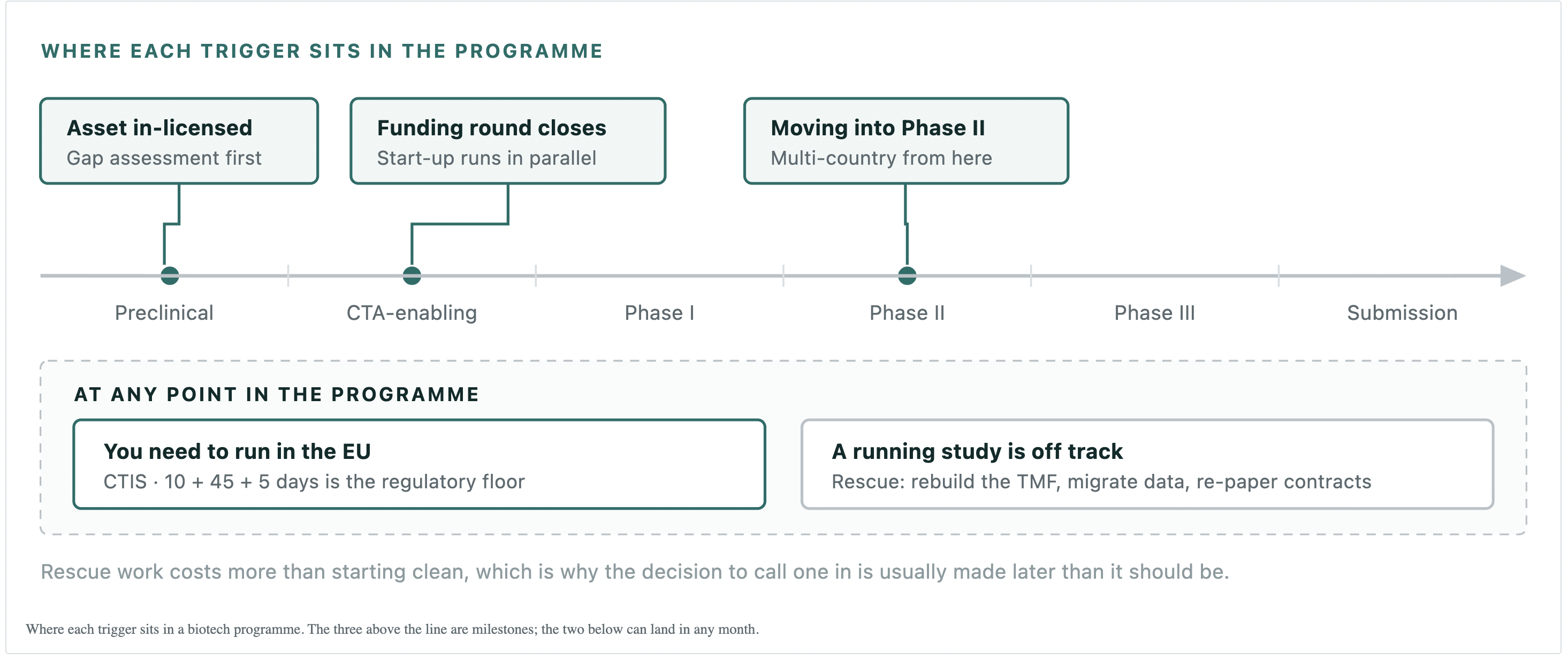
You have just closed a funding round
The money exists, the clinical team does not, and the milestone you sold to investors has a date attached. This is the point where start-up time is worth the most, and where a CRO earns its fee by getting the dossier and the sites moving in parallel rather than in sequence.
You have in-licensed an asset
You have inherited a data package of uncertain quality and need to know what is usable before designing anything. The first task is not a study — it is an honest gap assessment of what the previous owner generated, and what a regulator will ask for that is missing.
You are moving into Phase II
A single-country study becomes multi-country, and everything that was manageable informally stops being so: multiple ethics timelines, drug supply across borders, monitoring at scale, and a data set large enough that its quality now depends on process rather than attention.
You need to run in the EU
A team whose experience is with the FDA meets a different structure — CTIS, a reporting Member State, ethics committees that are separate from the national agency, and documents required in each local language. The regulation sets the clock: validation within 10 days, the Part I assessment report within 45 days of validation, and the single national decision within 5 days of the reporting date (Regulation (EU) No 536/2014, Articles 5–8). Sixty days is the floor for a clean application, and every request for further information adds to it.
A running study is off track
Enrollment has stalled, a vendor is not delivering, or the data will not survive review. Rescue work is its own discipline: taking over a trial mid-flight means reconstructing the TMF, migrating data between systems, re-papering site contracts and re-training sites, all while patients stay on treatment. It costs more than starting cleanly, which is why the decision is usually made later than it should be.
Full-Service or FSP: Choosing an Engagement Model
| Full study conduct | Functional support (FSP) | |
|---|---|---|
| Who manages the study | The CRO | The sponsor |
| What the CRO delivers | The complete cycle, from design to the final study report | One or more functions: monitoring, data management, biostatistics, medical writing, regulatory affairs |
| Fits when | There is no internal clinical operations function, or the first multi-country study is starting | A study manager is in place and a specific capability or capacity is missing |
| The sponsor still needs | Someone to own oversight — the responsibility does not transfer | Enough internal bandwidth to coordinate across functions and vendors |
| Where it goes wrong | Oversight treated as a formality until an inspection asks for evidence of it | Gaps between functions that no single provider owns |
Both models are described on our clinical trial support services page, and the functional model in more depth in functional service provider.
How to Choose a CRO for a Biotech Trial
Most RFP questions get the same answer from every vendor. These do not:
- How many clinical trial applications have you submitted through CTIS, and which Member States acted as reporting Member State?
- Which national ethics committees have you worked with directly in the past two years?
- Which languages do you handle in-house for informed consent forms and patient materials, and which go to a translation vendor?
- Is the EDC yours, licensed, or the sponsor’s — and who pays for configuration changes after a protocol amendment?
- Who is on this project by name, what else are they staffed on, and will they still be there at database lock?
- What enrollment rate are you assuming per site per month, and what is it based on?
- How are scope changes priced, and what has triggered change orders on your last three studies?
- What is your process when a site underperforms — at what point do you escalate, and to whom?
- Which of your SOPs govern the work being outsourced, and when were they last revised?
- What certifications do you hold, and what are their dates?
- Have you been inspected, and what were the findings?
- Which activities would remain with us under your standard transfer-of-duties schedule?
- What happens to the data and the TMF if we terminate the contract early?
- Can we speak to a sponsor of comparable size that you worked with?
The last one separates vendors more reliably than any of the others.
Running a Biotech Trial in Poland and Eastern Europe
Poland has become one of the larger clinical trial markets in the EU, and for a biotech sponsor the reasons are practical. Large public hospitals concentrate patients in single centres, which means fewer sites for the same enrollment. Treatment-naive populations in several indications recruit faster than saturated Western European sites competing for the same patients. Costs per patient are lower without leaving the EU regulatory framework — the data are generated under Regulation (EU) No 536/2014 and go into the same dossier.
The structure to plan around: applications go through CTIS; the national competent authority in Poland is URPL; and the ethics committee opinion is a separate process from the regulatory assessment, not a step inside it. Both feed the single national decision, and both have to be tracked.
The trade-off is worth stating. Central and Eastern European sites are strong on recruitment and cost, and the region is not the right primary choice for every indication or every regulatory strategy — a programme built around US registration with an FDA end-of-Phase-II position needs its geography argued rather than assumed.
We cover the region in more detail in why Poland is a perfect place for clinical trials and the role of Eastern Europe in global clinical trials.
Frequently Asked Questions
What is a biotech CRO?
A contract research organization that runs clinical trials for biotechnology companies. The services are the same ones any CRO provides — regulatory submission, site management, monitoring, data management, biostatistics, medical writing — organized for sponsors that outsource most of the trial rather than selected parts of it.
Why do biotech companies use CROs instead of hiring in-house?
Building a clinical operations function takes longer than the trial and commits the company to fixed costs across the gaps between studies. A CRO converts that into a project cost, and supplies experience the company would otherwise be hiring for the first time — including regulatory routes it has never used.
How much does it cost a biotech company to work with a CRO?
It depends on the number of countries and sites, study duration, patient visits and procedures, monitoring intensity, and the data package required. For the EDC portion specifically, Pharmaxi prices on eCRF complexity, number of patient visits, number of eCRF fields and how long the system stays live, plus configuration, validation and remote data-quality monitoring. Ask any CRO to break a quote down by these drivers — a single number cannot be compared.
What is the difference between a biotech CRO and a full-service CRO?
They are not opposites. “Full-service” describes scope — the CRO runs the whole study. “Biotech CRO” describes the client and the operating model: senior staff on the project, fewer layers, and a scope that assumes no internal clinical operations team on the sponsor side. A full-service CRO can be either.
Can a small biotech afford a full-service CRO?
Often yes, if the study is scoped to the question being answered rather than to the largest possible data set — country count, site count and visit schedule are what move the price. For a single-asset programme a mid-sized CRO is usually the closer fit, because the same people stay on the study from start-up to database lock.
How long does it take to start a clinical trial in the EU?
The regulatory floor is about 60 days from submission for a clean application: 10 days for validation, 45 days for the Part I assessment report, 5 days for the decision (Regulation (EU) No 536/2014). Requests for further information extend it. Site contracts and ethics submissions run in parallel with that clock, so the practical start-up time depends on how early they begin.
Is it contract research organisation or organization?
Both are correct — “organisation” is the British and EU spelling, “organization” the American one. ICH guidelines use “organisation”. They mean the same thing, and both abbreviate to CRO.
Who is responsible for the trial — the sponsor or the CRO?
The sponsor. ICH E6(R3) allows a sponsor to transfer any or all trial-related activities to a service provider, but the ultimate responsibility for participants’ rights, safety and well-being and for the reliability of the data stays with the sponsor. Activities not specifically transferred in the agreement remain with the sponsor by default.
Working With Pharmaxi
Pharmaxi is a mid-sized CRO founded in Warsaw in 2013 by two physicians, running Phase II–IV and large non-interventional studies in Poland, Ukraine and other Eastern European countries. Sponsors come from 21 European and North American countries, and multi-country delivery runs through a network of 79 partner companies. Alongside Sanofi, AbbVie and Takeda, the client list includes small sponsors — Sankom, Peptigroup and Flyser — which is the segment this page is about.
The concrete reference point for biotech work is a multi-centre randomized double-blind placebo-controlled COVID-19 trial: 540 patients across 17 sites.
“Immune Biosolutions’ COVID trials were delivered on timeline and within budget.”
— Luc Paquet, CEO, Immune Biosolutions
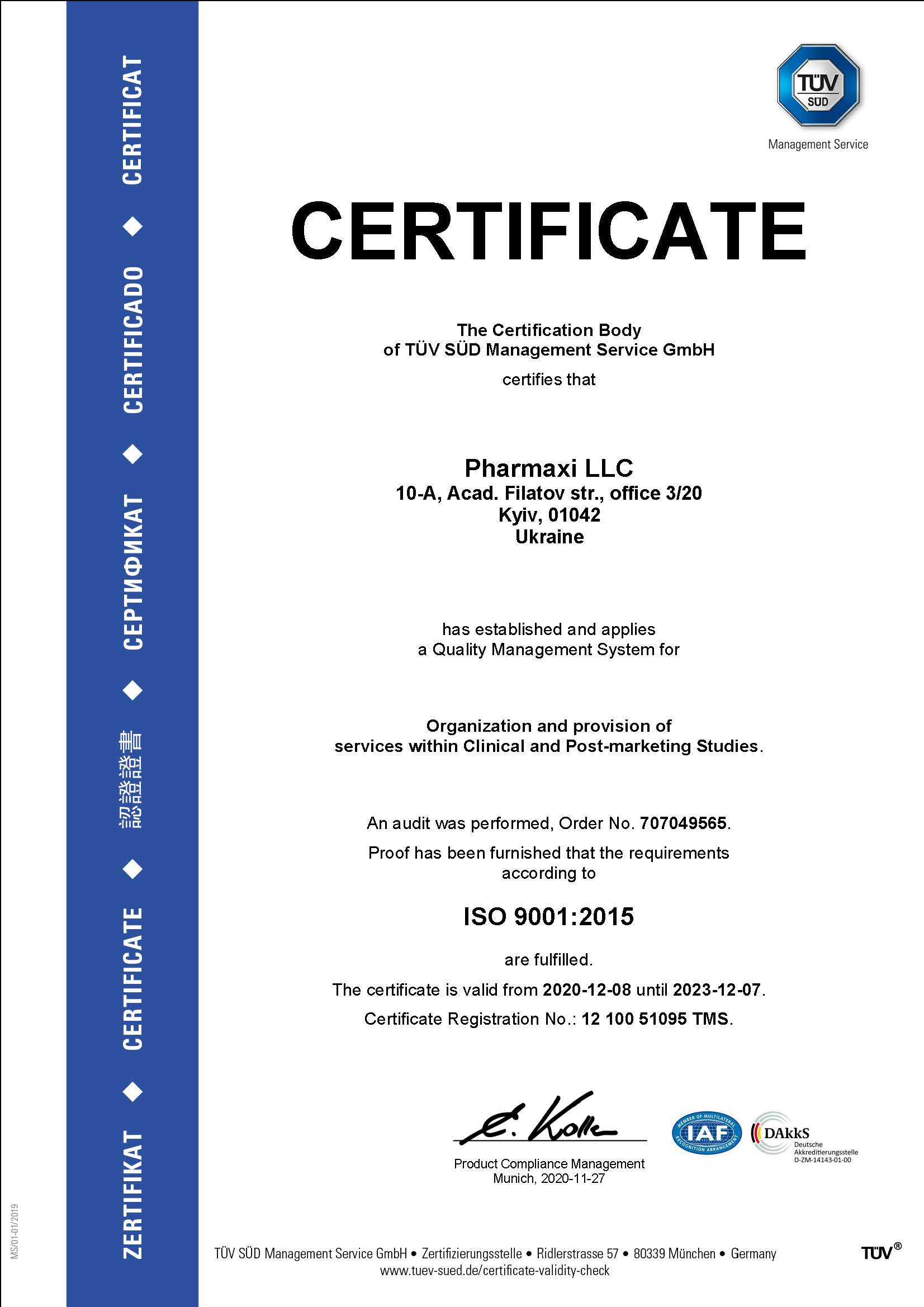
Data management runs on OnlineCRF, our own EDC platform, under 21 CFR Part 11 and GAMP 5. Quality management is certified to ISO 9001:2015 by TÜV Austria.
Book a free 30-minute consultation with a project manager, regulatory expert or data manager — 09:00–18:00 Polish time. No cost, no obligations.
References
- ICH E6(R3) Guideline for Good Clinical Practice, glossary and section 3.6 — adopted January 2025
- Regulation (EU) No 536/2014 on clinical trials on medicinal products for human use, Articles 5–8
- Clinical Trials Information System (CTIS), European Medicines Agency
- Urząd Rejestracji Produktów Leczniczych, Wyrobów Medycznych i Produktów Biobójczych (URPL), Poland